
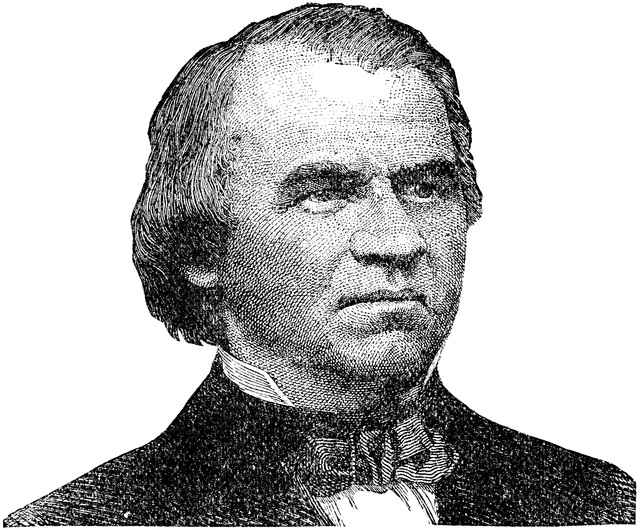
loola-games.info – The presidency of Andrew Johnson marked one of the most tumultuous and controversial periods in American history. Ascending to the nation’s highest office after the assassination of President Abraham Lincoln, Johnson was confronted with the daunting challenge of leading a fractured country that had just endured four years of brutal civil war. As the 17th president, Johnson faced an uphill battle to reunite a divided nation while also navigating the complex and sensitive issue of how to bring the Southern states back into the Union after their rebellion in the Civil War. His approach to Reconstruction—his plan for restoring the Southern states to the Union—would ultimately shape the trajectory of post-war America. But it would also generate significant political and social tensions that would leave lasting scars on the country for years to come.
This article explores the challenges Andrew Johnson faced in his efforts to reunify a nation torn apart by war and secession, examining his policies, his clashes with Congress, and the lasting consequences of his approach to Reconstruction. From his early political views to his handling of the post-war South, Johnson’s presidency was marked by a constant struggle to balance political expediency with the difficult realities of a nation rebuilding after the deadliest conflict in American history.
The Southern States and the Question of Reentry
The Aftermath of the Civil War
By the time of Abraham Lincoln’s assassination in April 1865, the Civil War was effectively over. The Union had won, and the Confederate States of America had been defeated. However, while the war itself had ended, the path to reunification was unclear. The nation was left grappling with the question of how to restore the Southern states to the Union and what terms would be required for their reentry. The four years of brutal conflict had left the South economically devastated, socially fractured, and politically divided.
When Andrew Johnson became president, the fate of the Southern states was in his hands. His plan for Reconstruction would be shaped by his own complex views on the Union, states’ rights, and racial equality. Johnson was a Southern Unionist, a man who had lived in the South but had remained loyal to the United States during the Civil War. His personal experience as a Southern Unionist led him to approach the post-war reconstruction process with a belief that the Southern states should be allowed to reenter the Union with as little punishment as possible, a stance that would put him at odds with many in the North, including members of his own party.
Johnson’s Approach to Reconstruction
Andrew Johnson’s plan for Reconstruction, known as the “Presidential Reconstruction Plan,” aimed to quickly restore the Southern states to the Union with minimal disruption. His approach was characterized by a lenient stance toward the South, with the primary goal being the rapid reintegration of the Southern states into the Union. Johnson offered a general amnesty to most Southern whites who pledged loyalty to the Union and accepted the abolition of slavery, which had been made law by the 13th Amendment.
Under Johnson’s plan, once a state had a majority of its voters swear an oath of allegiance to the Union and ratified the 13th Amendment, it would be allowed to send representatives to Congress and resume its participation in the Union. This approach effectively gave the Southern states the power to quickly regain political control, with relatively few restrictions placed on their leaders. Johnson’s plan was meant to be a generous and swift process, aimed at healing the divisions created by the war.
However, the leniency of Johnson’s plan soon created significant backlash. Many in the Northern states, particularly the Radical Republicans in Congress, believed that Johnson’s policies were too forgiving and failed to address the underlying social and political inequalities that had led to the war. In particular, Johnson’s refusal to provide for the rights and protection of newly freed slaves angered the Radical Republicans, who sought more drastic measures to ensure that the Southern states would not return to their old ways.
The Radical Republicans: A Growing Opposition
The Rise of Radical Reconstruction
As Johnson pushed forward with his plan for Reconstruction, he faced increasing opposition from a powerful faction of Congress known as the Radical Republicans. The Radical Republicans were led by figures such as Thaddeus Stevens and Charles Sumner, who sought to impose a much stricter set of conditions on the Southern states before they could rejoin the Union. They were deeply committed to ensuring that the South did not revert to its pre-war ways, particularly with regard to the treatment of African Americans.
The Radical Republicans wanted to secure full civil rights for freed slaves, and they believed that the South should be punished for its role in the rebellion. They were determined to dismantle the old Southern political system, which they saw as inherently corrupt and based on racial oppression. To do so, they pushed for new policies that would protect the rights of African Americans and reshape Southern society.
One of the key points of contention between Johnson and the Radical Republicans was the issue of voting rights for African Americans. While Johnson’s policies were silent on the issue of black suffrage, the Radicals believed that it was essential for African Americans to be granted the right to vote in order to ensure their full participation in the political process. This would guarantee that African Americans would have a voice in the new Southern governments that were being formed as part of the Reconstruction process.
The Black Codes and Johnson’s Response
As Southern states began to rejoin the Union under Johnson’s plan, many of them passed “Black Codes”—laws that severely restricted the freedoms of newly freed African Americans. These laws aimed to restore much of the old Southern social order by controlling the labor and movement of African Americans, while maintaining the racial hierarchy that had existed before the Civil War. The Black Codes were seen as an attempt to undermine the progress of emancipation, and they sparked outrage in the North.
Johnson’s refusal to directly address the issue of Black Codes further alienated him from the Radical Republicans. Many Northern lawmakers believed that the Black Codes were a clear indication that the South had not truly changed, and they argued that more stringent measures were necessary to ensure that the rights of African Americans were protected. Johnson, however, believed that the Southern states should be trusted to manage their own affairs and that federal intervention was not necessary.
The passage of the Black Codes, coupled with Johnson’s refusal to take a firm stance against them, led to a growing sense of frustration and distrust among the Radical Republicans. They saw Johnson as an impediment to the type of Reconstruction they believed was necessary to create a more just and equal society.
The Battle for Control of Reconstruction
Johnson vs. Congress
As 1866 unfolded, the conflict between Andrew Johnson and Congress came to a head. In an effort to challenge Johnson’s policies, the Radical Republicans passed several pieces of legislation that were designed to reshape Reconstruction and ensure that African Americans were granted full civil rights.
The Civil Rights Act of 1866 was one of the most significant pieces of legislation passed by Congress during this period. It sought to provide African Americans with citizenship and equal protection under the law, overriding the Black Codes. Johnson, however, vetoed the bill, arguing that it was unconstitutional and that it represented an overreach of federal power. In response, Congress overturned Johnson’s veto, marking the first time in U.S. history that a presidential veto had been overridden in this way.
Following this victory, Congress passed the Reconstruction Act of 1867, which divided the South into five military districts and placed them under federal control. This law effectively stripped the Southern states of their autonomy and forced them to comply with federal requirements, including granting the vote to African American men and ratifying the 14th Amendment, which granted citizenship to all people born in the U.S.
Johnson’s veto of these measures further deepened the rift between the president and Congress. The Radical Republicans now sought to limit Johnson’s power, and they moved to impeach him in 1868 for violating the Tenure of Office Act—a law that prohibited the president from removing certain officeholders without the approval of the Senate. Though Johnson was acquitted by a single vote in the Senate, his political power was severely weakened, and Congress effectively took control of Reconstruction.
Conclusion: The Struggles of Reunification
Andrew Johnson’s presidency was marked by a deep and persistent struggle to reunify a nation torn apart by war. His lenient approach to Reconstruction and his steadfast belief in states’ rights placed him at odds with the Radical Republicans, who sought a much more aggressive approach to rebuilding the South and ensuring civil rights for African Americans. Johnson’s refusal to address the deep social and political inequalities of the South ultimately undermined his presidency and left the nation in a state of limbo.
Despite his good intentions to quickly restore the Southern states to the Union, Johnson’s presidency is often seen as a failure in terms of its ability to heal the divisions of the Civil War and promote lasting unity. The Reconstruction era, while essential in shaping the course of American history, was a period of deep political conflict and social unrest. Andrew Johnson’s role in this era highlights the challenges of reunification after a devastating war, and his presidency remains a testament to the complexities of governing a nation on the brink of transformation.